

Back in June, I wrote that Salesforce didn’t buy Contentful. They bought Agentforce’s brain.
My thinking was simple. Websites need content. AI agents need knowledge. Contentful gives Salesforce a structured, governed content layer that Agentforce can work with.

Then Salesforce and Anthropic announced Claudeforce, and it made me ask:
Do we really think everyone is going to work inside Claude?
Probably not.
Some organisations will use Claude. Others will standardise on ChatGPT, Gemini or Copilot.
Some might even work old school either non AI or with pen and paper, imagine that.

Agentforce will make sense for Salesforce-heavy organisations, while Slack and Teams are becoming AI interfaces themselves.
That was why I thought the really interesting announcement wasn’t Claudeforce. It was Headless 360.
Headless 360 started separating what Salesforce does from the Salesforce interface. If Salesforce could expose its data, workflows, permissions and business capabilities to AI, perhaps it didn’t need to own the interface anymore.
At the time, that was my interpretation of where this was going.
Then Dreamforce happened.
Salesforce announced AIforce

Well, that didn’t take long.
The interesting thing about AIforce isn’t another Salesforce product with “AI” in the name. It’s the architecture behind it.
Salesforce describes AIforce as bringing its data, workflows, business logic, semantics, permissions, security and governance to any AI interface.
Not just Agentforce. Not just Claude. Any AI interface.
Suddenly the pieces fit together.

Salesforce still sits underneath.
For decades we’ve bought enterprise software and taught people how to use it.
- Want to manage a customer? Open the CRM.
- Update a page? Go into the CMS.
- Need an image? Open the DAM.
- Product information? That’s the PIM.
AI will change that model.
Instead of understanding which systems are involved, the user describes the outcome they want and an agent works out which capabilities it needs.
Imagine a marketer saying:
“Create a landing page for our new UK campaign using the approved messaging and current product information. Find imagery licensed for the UK market, create versions for our three main customer segments and send everything to compliance for approval.”
Generating the page is increasingly the easy part.
The hard part is knowing whether the messaging is approved, whether the product information is current, whether the imagery is licensed for that market, whether AI can modify it, who has permission to publish and whether compliance needs to approve it.
Suddenly all the boring stuff becomes incredibly important: metadata, taxonomy, relationships, permissions, rights management, workflow, brand governance, compliance and provenance.
AI can create 10,000 variations without breaking a sweat.
The challenge is making sure it creates 10,000 things that it should.
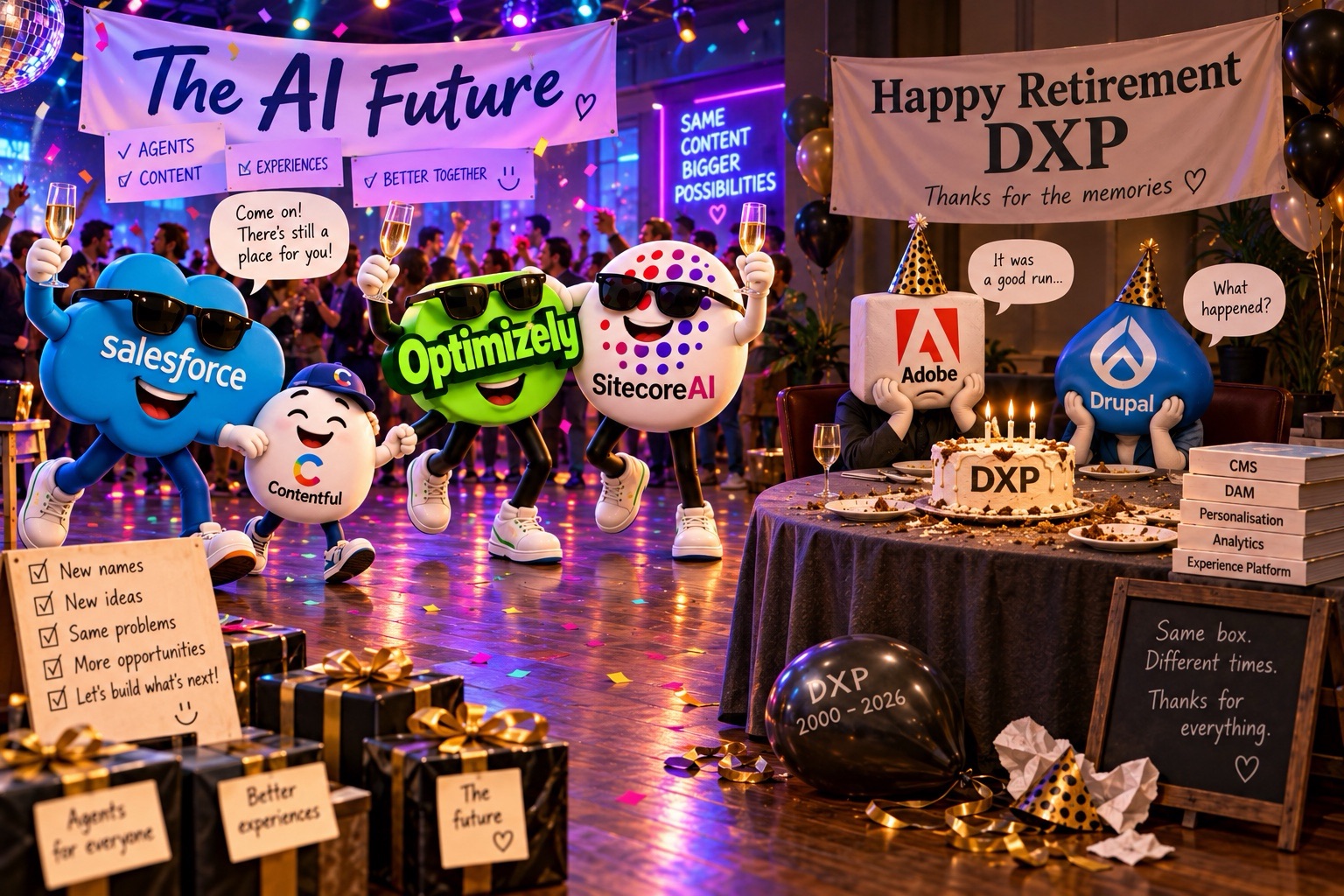
That’s why I don’t think AI makes CMS, DAM, PIM or CRM less relevant.
It could make the platforms underneath them more important while making their interfaces less important.
Salesforce appears to be making the same bet about CRM.
And that changes what I think the next competitive battle looks like.
It’s probably not:
Who has the best AI assistant?
Everyone will have one.
The much more interesting question is:
Which platform can give AI the best governed understanding of an organisation and safely allow it to act?
An LLM can write copy, generate an image or build a landing page. What it doesn’t inherently understand is your products, customers, content, brand rules, permissions, workflows and regulatory obligations.
That enterprise context is where the value starts to shift.
Which brings me back to Contentful.
When Salesforce announced the acquisition, I wrote a blog:
Salesforce didn’t buy Contentful. They bought Agentforce’s brain.
I still like the argument. But after AIforce, I think I’d change it slightly.
Maybe Salesforce bought part of the governed content layer for an architecture where the AI interface itself becomes interchangeable.
If that’s the direction, Salesforce doesn’t have to predict whether Claude, ChatGPT, Gemini, Copilot or something else becomes the dominant way people interact with AI.
Its content, data, context, workflows, permissions and business capabilities can sit underneath them.
And that’s why I think AIforce is interesting.
It’s not really about another AI assistant. It’s about a different view of enterprise software, where the CRM, CMS, DAM and PIM increasingly become governed capability layers that agents can reason over and act through.
Salesforce doesn’t necessarily need to win the AI interface war. It just needs to be useful behind whoever does.
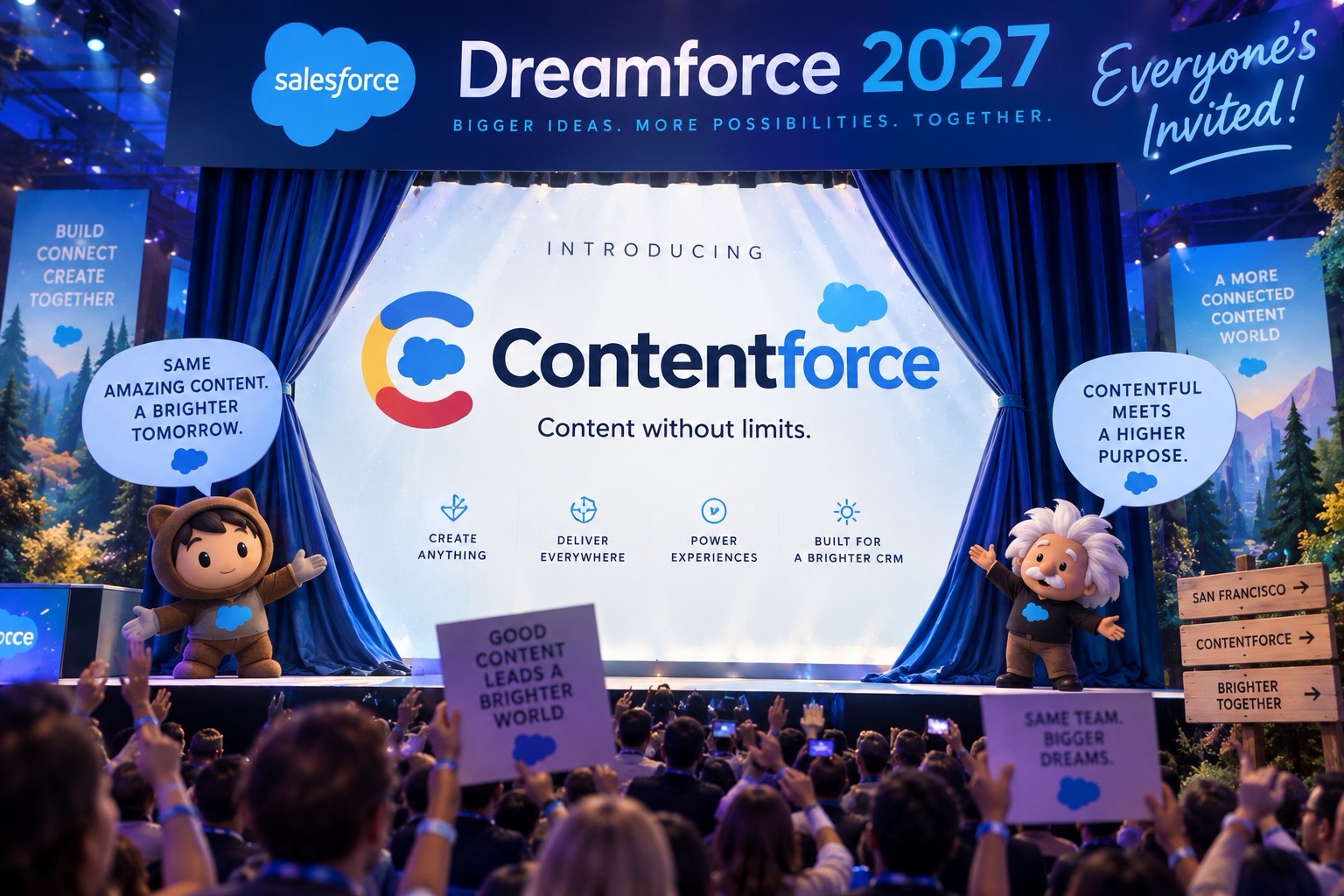
I’m calling it now though – Dreamforce 2027 they will announce Contentforce

Leave a Reply