

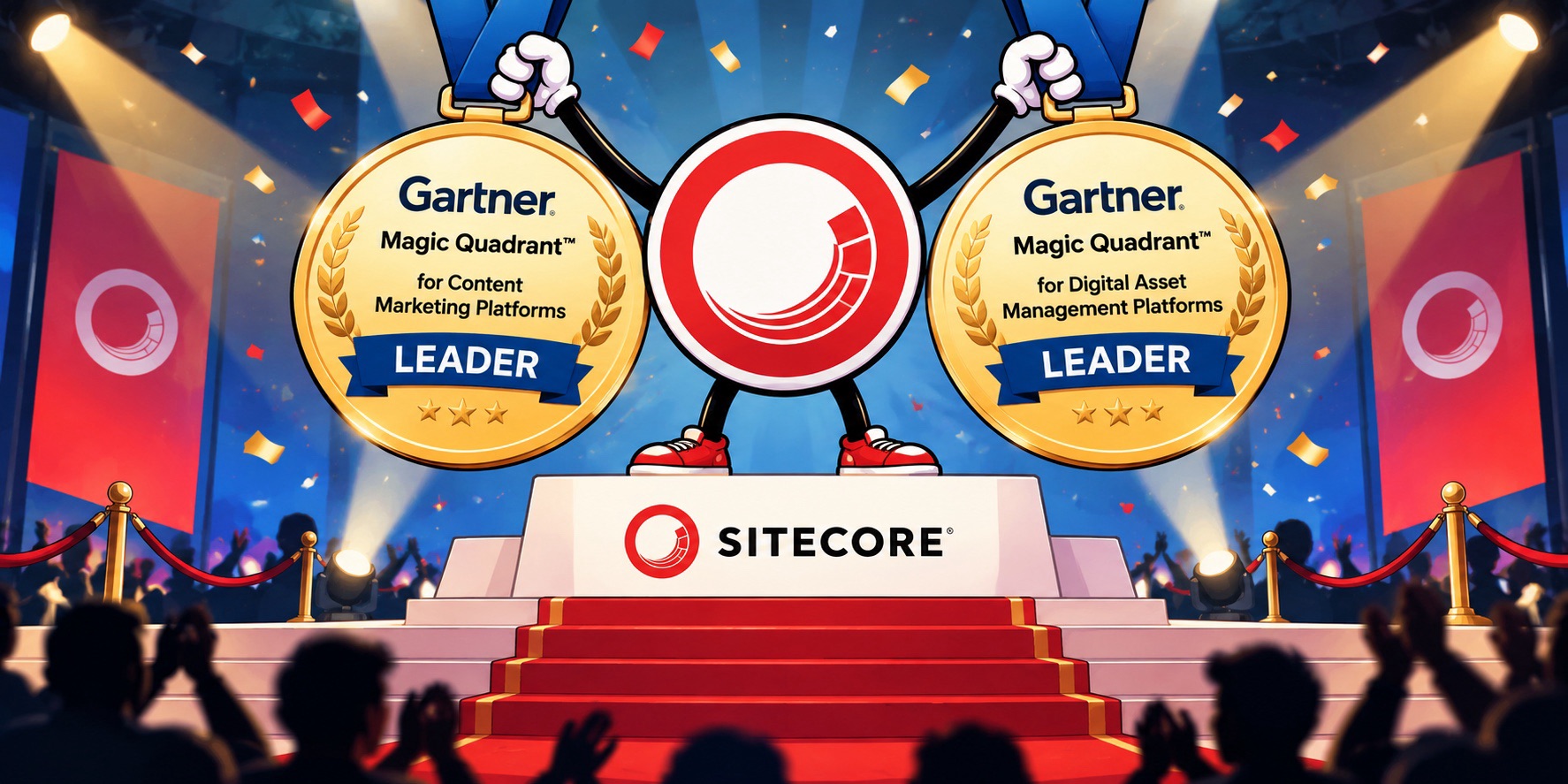
Two Leader badges, one platform

Sitecore is now a Leader in both the Gartner Magic Quadrant for Content Marketing Platforms and the one for Digital Asset Management Platforms. The CMP result landed in April 2026, with Sitecore positioned furthest on Completeness of Vision. The DAM result followed in October, in a report Gartner dated 26 October 2026.

Full disclosure before I go any further: I’m a Sitecore MVP and a Senior Solution Architect at EPAM, I always try and be neutral but this is an amazing platform.
I’ve also been writing about Content Hub for a while, including the lightweight DAM idea in SitecoreAI, so none of this comes from nowhere.
The DAM result is the bigger move. In the January 2025 edition, Sitecore sat in the Visionaries quadrant for Content Hub. Now it’s a Leader.
I made a big thing about this when the CMP report came out.
Not the only one, but built differently
The obvious line here would be that Sitecore is the only vendor with both badges. It isn’t. Adobe, Aprimo and Storyteq all appear as Leaders across the 2025 DAM and 2026 CMP quadrants, and Storyteq has been vocal about it.

So the badge count isn’t the story. What sits behind each badge is.
Adobe is the two-product case. The DAM quadrant is about AEM Assets, while the CMP quadrant looks at other AEM tools. They work together, but they are separate things you buy and connect. Aprimo and Storyteq are different. Each is a single platform that appears in both reports, and both come at it from the asset and marketing side: a DAM or content marketing platform that has grown outwards.
Sitecore comes from the other direction. SitecoreAI starts with content and experience delivery, and brings DAM, content operations and product content management into the same system. That’s my read, not Gartner’s, and the full reports are where to check it. But it changes the question. It’s less “who has two badges?” and more “where does the middle live?”, the space between creating content and delivering it.
The space in between
The interesting part of SitecoreAI DAM is the gap between the two categories. A DAM is good at the asset: store it, tag it, control who can use it, track the rights. A content marketing platform is good at the work around it: the brief, the plan, the calendar, the approval.

Most real problems live between them. Who asked for this image? Is the approved version the one that actually went live? Which claims were cleared for which market? That gap is content operations, and asset operations are the other half of it. Neither a pure DAM nor a pure CMP owns it, and the quadrants tend to judge vendors from one side or the other.
Two Leader positions say Gartner sees Sitecore as credible on both sides. The product argument is that SitecoreAI is built to run in the middle, as a single place for content and asset operations.

It matters more now because of AI. Once agents are producing variations, localising copy and pulling images, volume goes up and the ability to say “this is approved, on brand and ours” becomes the whole game. Sitecore’s own line is that the DAM is the governed content layer for AI systems as well as people. I think that’s right. An ungoverned asset library feeding an AI is just a faster way to publish the wrong thing.
What to ask in a demo
If you’re shortlisting, test the middle with your own messy content. Four questions I’d put to any vendor, Sitecore included:
- Where does a brief live, and can I follow it all the way to the final approved asset without leaving the platform?
- When an asset is updated or withdrawn in the DAM, what happens to the plans, drafts and published content that use it?
- What can an AI agent do in the middle, and what stops it stepping outside brand and rights rules?
- What is included in the price? Sitecore says AI capabilities are part of the platform without credit or token limits, so ask what that looks like in a real contract.
Where I land
Two Leader positions in one year is a strong result, and it fits something I’ve been saying for a while.
I know what Sitecore DAM can do, it’s the best platform on the market.
DAM stops being a library and becomes the control point for content. I’d still treat it as a reason to book a demo, not a reason to skip one. Read the full reports, check the strengths and cautions, and see how each platform copes when the work gets messy. That’s where they stop looking alike.
Leave a Reply