


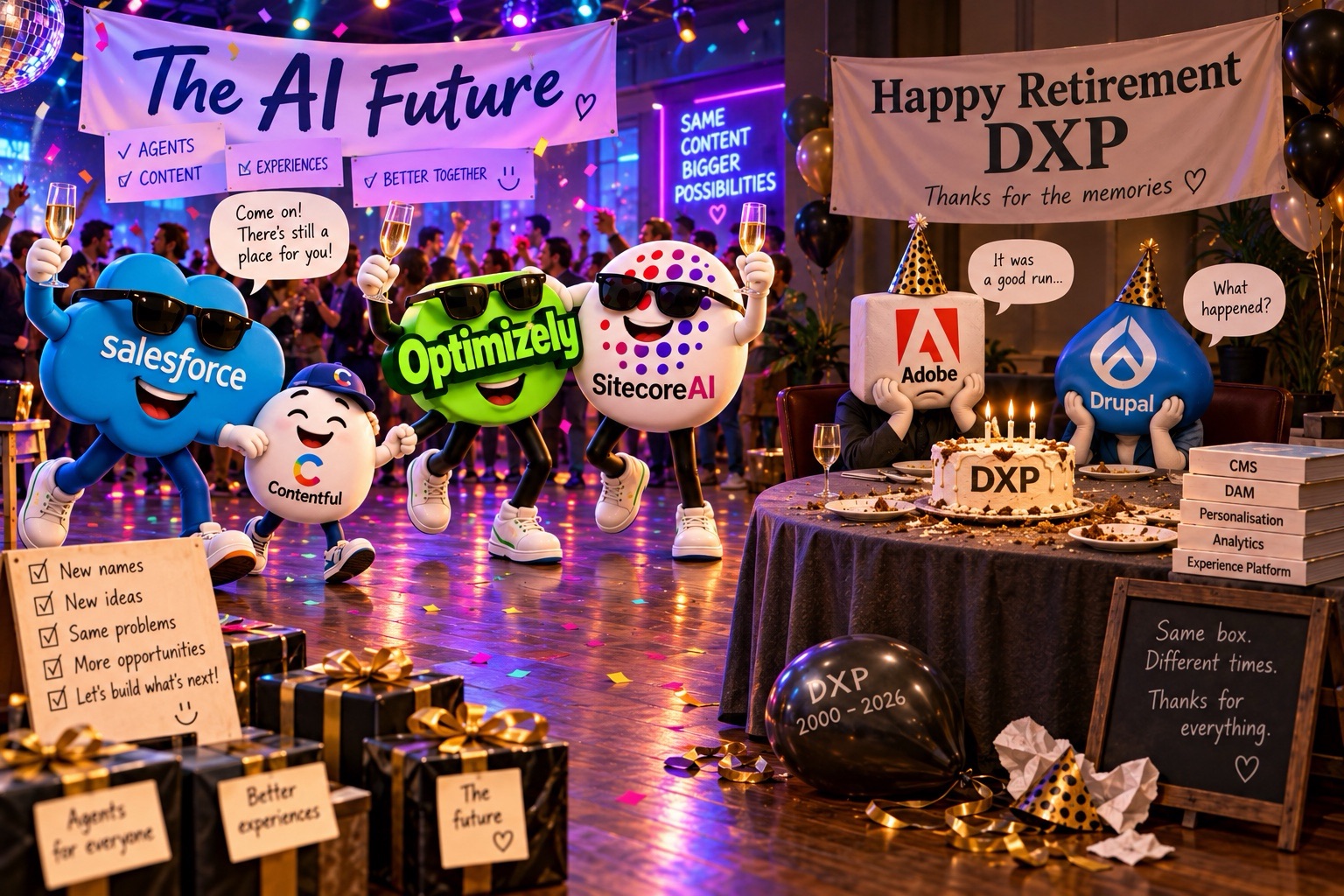
For years, DXP was the destination.
Every major digital experience vendor seemed to be heading there. Start with a CMS, add DAM, personalisation, experimentation, analytics, customer data, commerce and whatever else you could acquire, put a box around it all and call it a Digital Experience Platform.
Now something slightly strange is happening.
The companies that spent years building DXPs are starting to stop calling them DXPs.

And it’s happening remarkably quickly.
I actually started writing this blog a few weeks ago but after reading this great one from Dom Nicastro inspired me to finish it.
Contentstack has moved to an Agentic Experience Platform. Optimizely now describes itself as an AI platform for marketing. Acquia is repositioning around an agentic content platform. Adobe is talking increasingly about Customer Experience Orchestration. Sitecore literally changed its identity to SitecoreAI.

Different names.
Different products.
Different starting points.
But there’s a pretty obvious pattern forming.
DXP is no longer the thing everyone wants to be.
Which is quite funny when you think about how much time this industry spent arguing about who had the best one.
But I don’t think this means the technology underneath the DXP is disappearing.
Quite the opposite.
CMS, DAM, PIM, CDP, experimentation, personalisation and analytics may actually become more important in an AI-driven world.
What’s changing is the layer sitting above them.
And increasingly, that layer looks like an agent.
So what happened to the DXP?
The original DXP idea made complete sense.
Digital experiences became more complicated, so vendors assembled more capabilities around the CMS. Content management wasn’t enough. Brands needed assets, customer data, personalisation, experimentation, commerce, analytics and marketing automation.
The answer was integration, well actually the promise of it.

For a while, the competition became almost architectural Top Trumps: who had the most complete suite, the biggest diagram and the most boxes in the analyst report.

AI changes that conversation because it introduces a completely different way of interacting with all those capabilities.
Instead of building an increasingly large platform interface and asking humans to navigate it, you can potentially put an intelligent orchestration layer above it.
And that’s where the recent announcements become interesting.
Everyone suddenly has an agent
This isn’t really an Optimizely story, an Acquia story or a Sitecore story.
It’s happening across the market.
Optimizely’s recent announcements are a good example. Its future is increasingly positioned around an Agent Platform, with persistent Virtual Teammates that have jobs, permissions, context and responsibilities.
Contentstack has Agent OS sitting at the heart of its Agentic Experience Platform.
Adobe is bringing agents, content, customer data, journeys and decisioning together through its Customer Experience Orchestration story.
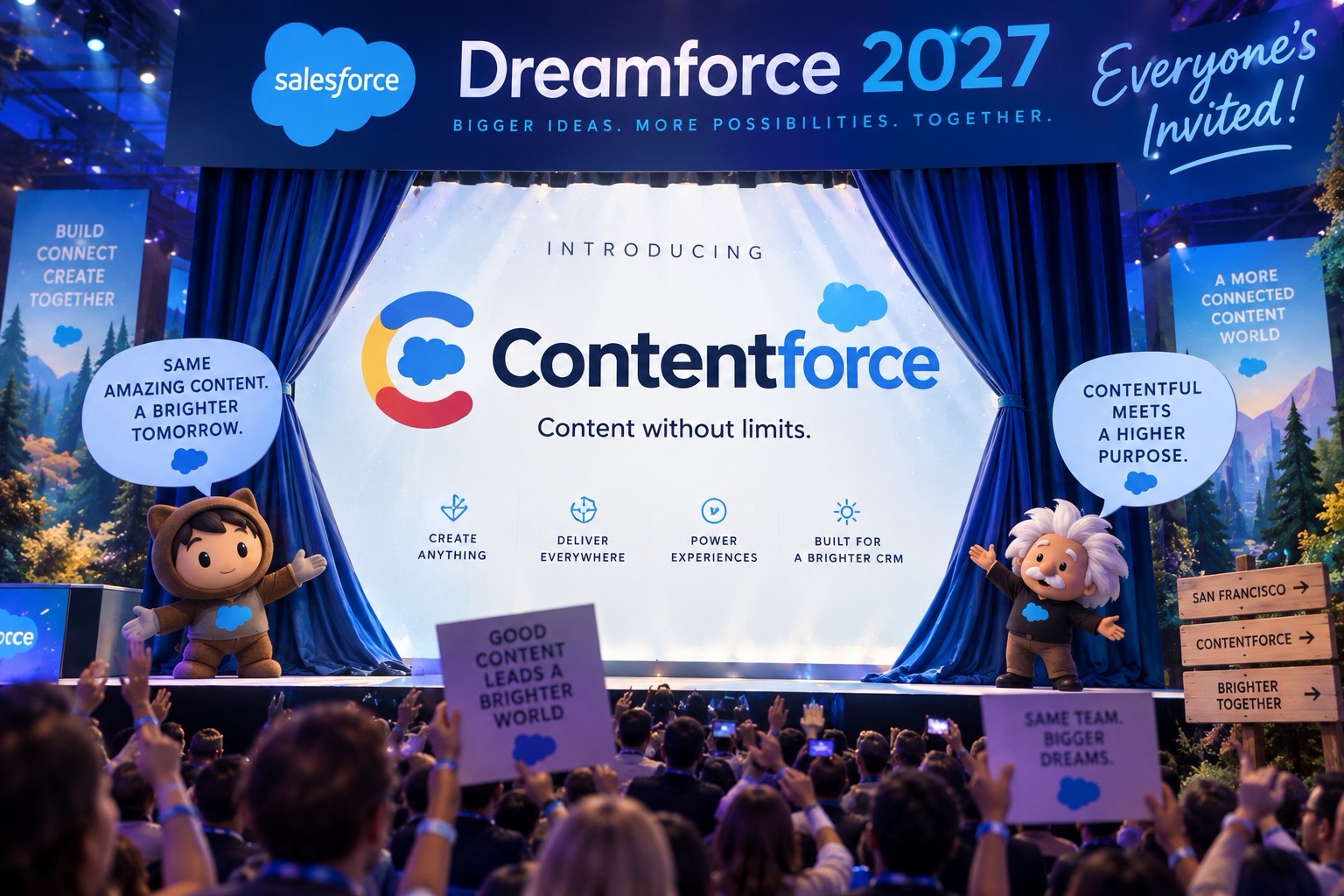
Salesforce has Agentforce, with Contentful potentially providing an increasingly important enterprise content layer underneath it.
Sitecore has SitecoreAI and Agentic Studio, while Scrunch extends the story into how brands are represented and discovered by AI systems.
And Acquia is now talking about its own agentic content platform, with structured content and governance at the centre.
Strip away the branding and there’s a surprisingly consistent architectural idea emerging:
Content + data + context + governance + capabilities + agents.
And that’s potentially a much bigger change than simply adding AI features to the DXP.


Leave a Reply