



Digital Asset Management has been around long enough that most people think they know what it is.
A repository. A place to store approved assets. A way to stop the marketing team emailing each other JPEGs.
That definition is out of date. And Sitecore Content Hub is a good example of why.
Where Sitecore sits in the market
In October 2025, Gartner placed Sitecore in the Visionaries quadrant of the Magic Quadrant for Digital Asset Management Platforms.
Strong vision, execution still being established.
The DAM Leaders quadrant at that point was dominated by Aprimo, Bynder, and Storyteq – all platforms built specifically around asset management as their primary use case.
Then in March 2026, Gartner named Sitecore a Leader in the Magic Quadrant for Content Marketing Platforms – positioned farthest right on Completeness of Vision among all vendors evaluated. Read my post here
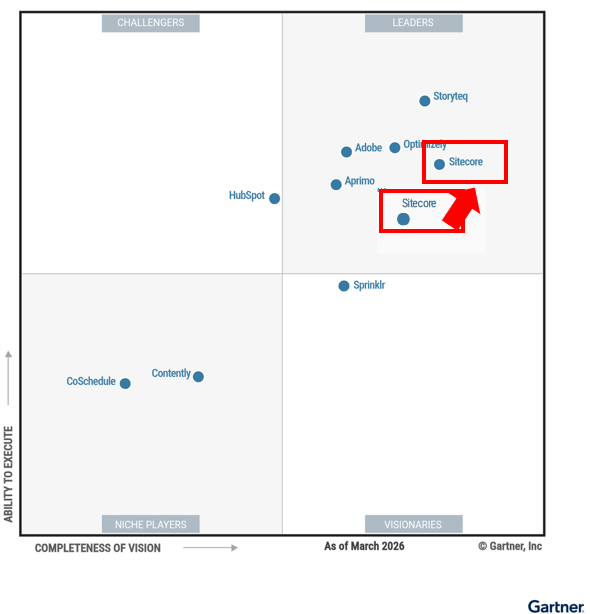
Two quadrants.
Two different capability sets.
One platform.
That combination tells you something important about what Content Hub actually is.
It starts with DAM, but it doesn’t end there
Most people only see the DAM because that’s where most implementations start. It’s the clearest use case, the easiest to justify, and the fastest to show value.
What sits behind it is considerably broader:
- DAM – digital asset management, search, tagging, rights management
- CMP – content marketing platform, editorial calendars, campaign planning
- MRM – marketing resource management, budgets, project management
- PCM – product content management, structured product data
These aren’t bolt-ons. They share a content model, a workflow engine, and a single taxonomy.

An asset created in DAM is immediately available to a campaign in CMP.
A product in PCM can reference approved assets without duplication.
The modules are genuinely integrated, not connected via API after the fact.
That’s a different product category to a pure play DAM. It’s a content operations platform that happens to have a strong DAM at its core.
What makes the CMP position significant
It’s worth me being precise here, because Aprimo – also in both quadrants – will make a similar argument about being unified.
Aprimo’s story is DAM plus content operations workflow. It’s strong on process and governance around assets: work management, budget management, production tracking. That’s genuinely useful and it’s why they’re a DAM Leader.
But Sitecore’s CMP position reflects something different. The CMP quadrant evaluates content strategy, editorial planning, campaign lifecycle management, and performance measurement. That’s not workflow management around assets – it’s the full content marketing planning layer from idea to delivery.
Sitecore sitting farthest right on vision in that quadrant, while also being in the DAM quadrant, means Content Hub spans a wider surface area than any other platform in either evaluation.
It’s not just that assets and content planning live in the same tool. It’s that they share the same data model, so a campaign knows what assets exist, what’s approved, what’s expired, and what needs to be created – without anyone having to manually bridge two systems.
That’s the structural difference. And it’s not something you can replicate by integrating a best-of-breed DAM with a best-of-breed CMP.
The case against pure play
The DAM Leaders quadrant is full of platforms that do one thing very well. Aprimo, Bynder, Storyteq – all strong, all focused, all built around asset management as their primary use case.
For some organisations that’s exactly the right answer. If DAM is genuinely your only problem and you have no need/appetite to consolidate your content stack, a pure play platform will tick every box on a feature checklist and probably score higher on DAM-specific depth today.
But most enterprise content teams don’t have a DAM problem in isolation. They have a DAM problem, a campaign planning problem, a content production problem, and a brand consistency problem.
All running in parallel, all managed in different tools that don’t talk to each other.
Buying the best standalone DAM on the market doesn’t solve that. It adds another system to an already complicated integration landscape.
And every integration point is a place where data gets out of sync, assets get duplicated, and governance breaks down.
Enterprise content complexity doesn’t need more specialised tools. It needs fewer, better connected ones.

That’s the bet Sitecore has made with Content Hub. And the evidence from two Gartner quadrants suggests the vision is landing – even if the DAM execution score still has room to move.
What this means practically
If you’re evaluating Content Hub as a DAM, you’re asking the right question but possibly looking at the wrong scorecard.
A pure DAM comparison will favour the specialists – that’s expected.

The better question is whether your content challenges extend beyond asset storage.
For most enterprise marketing teams they do. Campaign planning happens in one tool, asset approval in another, budget management somewhere else entirely.
Each handoff is friction. Each system boundary is a place where context gets lost.
Content Hub’s value isn’t that it’s the best DAM on the market. It’s that it’s the best platform for organisations that need DAM and everything that surrounds it – without building their own integration architecture to hold it together.



 Tim's Blog
Leave a Reply