

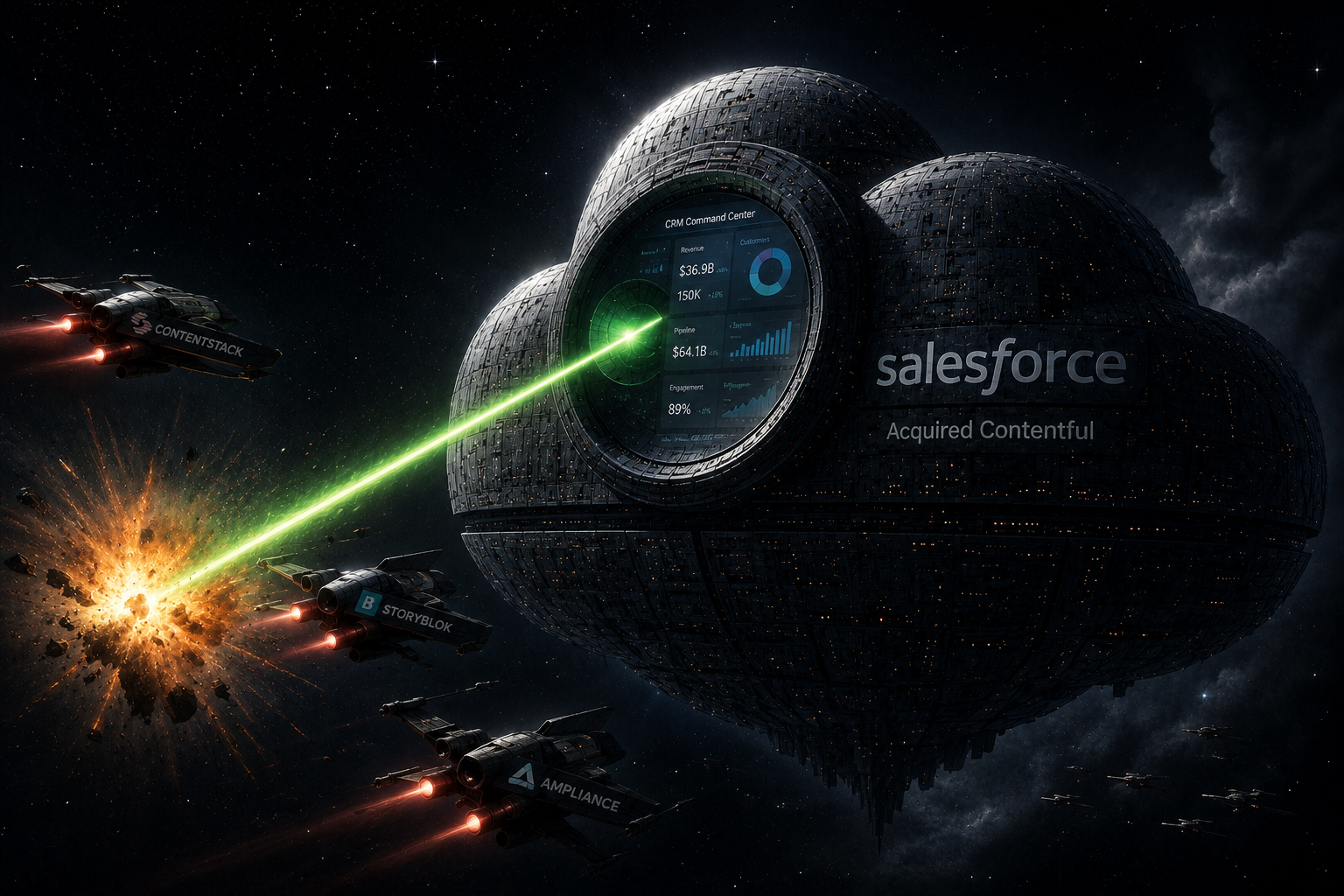
Disclaimer: I’m watching the Star Wars films with the kids and thought the theme was fun

The composable revolution was supposed to be permanent.
Best-of-breed vendors.
Open APIs.
No more monolithic empires telling you which tools to use.
The Rebel Alliance was winning.
Then Salesforce bought Contentful.

The Empire struck back. And it brought a content layer.
What actually happened
Salesforce announced this morning it has signed a definitive agreement to acquire Contentful, a headless CMS trusted by over 4,800 enterprise brands. The deal is expected to close in Q3 of Salesforce’s fiscal year 2027.
The strategic logic is straightforward. Salesforce has Agentforce, its AI agent platform, and Data 360, its customer data layer.
What it didn’t have was a proper content layer sitting between the data and the customer experience. Contentful fills that gap.
Agents can now query, assemble, and deliver structured content dynamically, without a human publishing step, without integration work, without a separate contract.
Salesforce customers are essentially getting a CMS bundled in. Which sounds like a joke until you remember they were previously paying for one separately and spending months wiring it up.
This isn’t your father’s monolith
To be clear, this isn’t a return to the dark side of locked-in, customised-to-oblivion platforms that took eighteen months to upgrade. Nobody is rebuilding AEM or Sitecore XP in a CRM. What’s emerging is something more interesting and, honestly, more defensible.
Call it the composable monolith.
API-first architecture, headless delivery, structured content, genuine developer flexibility. But owned, integrated, and sold by a single vendor who controls the roadmap across the whole stack.
It looks composable from the outside. It behaves like an ecosystem from the inside. And it lands on one invoice.
That’s not a step backwards. For most enterprise buyers, that’s actually the goal.
The Empire has company
Salesforce isn’t alone in this. Adobe has been building this play for years. Experience Manager, Marketo, Target, Analytics. One contract. One set of APIs that were designed to talk to each other before you wrote a line of code.
Sitecore took a different path, and it’s worth saying clearly: it’s a genuinely good one. Content Hub, XM Cloud, and SitecoreAI are built around how content teams actually operate. DAM, CMP, CMS, and AI governance on a shared backbone.
It’s a content and operations platform first, not a CRM with content bolted on. That’s a real and meaningful distinction, and for organisations where content production is the core workflow, Sitecore’s approach is arguably the better fit.
Optimizely has been quietly assembling a similar story around CMS, experimentation, and commerce.
And now Salesforce has arrived with the largest enterprise sales force in the industry and a content platform ready to ship.

The Rebel Alliance is getting smaller
The Rebel Alliance – sorry, the MACH Alliance – will probably quite possibly lose one of its founding members. Contentful helped write the composable playbook. API-first, headless, cloud-native, best-of-breed. It was one of the vendors that made the whole argument credible. And now it sits inside the Death Star.

That’s not a criticism of the deal. It makes sense for both sides. But it’s hard to imagine a vendor that has just been absorbed into the Salesforce ecosystem remaining an active champion of vendor independence. MACH membership will probably be one of the quieter casualties of this acquisition.
The Alliance carries on. But it just probably got a seat lighter from 2028.
If you’re Contentstack, Storyblok, or any other independent headless vendor, your pitch just got harder.
Not impossible. But harder.
You can win on developer experience.
You can win on pricing.
You can win on flexibility for genuinely complex multi-channel architectures.
There are real customers who need exactly what you offer and will never be happy inside a single vendor ecosystem.
But you are now competing, in a growing number of enterprise deals, against “already included.” That’s not a product problem. That’s a gravity problem.
What this means if you’re making platform decisions now
If you’re a Salesforce shop, pay attention to how Contentful gets integrated over the next 12-18 months. The pitch is compelling. The reality will depend on how much of Contentful’s composability survives contact with the Death Star roadmap.
If you’re on Sitecore, Adobe, or Optimizely, you’re already inside one of these ecosystems. The question isn’t whether to pick one. It’s whether the one you’re on is the right fit for what you actually do with content.
If you’re genuinely multi-vendor and intend to stay that way, the composable approach still works. But be honest with yourself about whether you have the engineering capability and organisational appetite to maintain it, because the vendors who were going to help you build that world are increasingly being absorbed by bigger Empire’s.
The composable dream of the early 2020s assumed the big platforms wouldn’t catch up. They have. They just did it without building a monolith.
Which, if you think about it, is far more dangerous.

The Force is strong with whoever controls the content layer.

Leave a Reply