

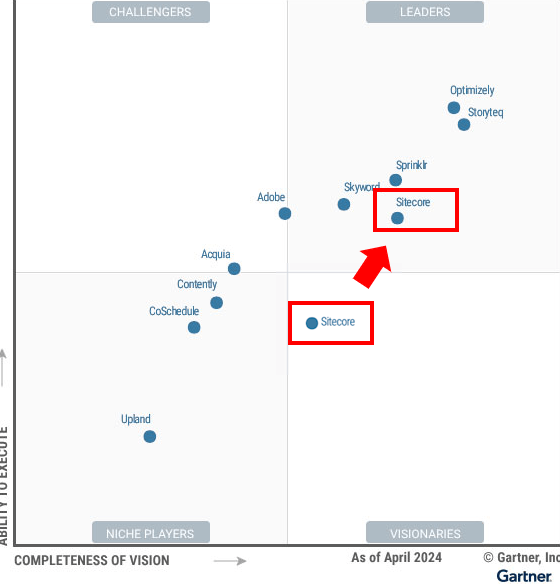
When Gartner published its Magic Quadrant for Content Marketing Platforms in March 2022, Sitecore sat in the Visionaries quadrant. Strong on vision, still building execution credibility. A platform with clear potential but not yet the full package.
By April 2024, that had changed. Sitecore was in the Leaders quadrant. I remember Roger Connolly telling me in person at Sugcon 2024 in Dublin, I was speaking at he was very excited as he found out the announcement was going out the next day.
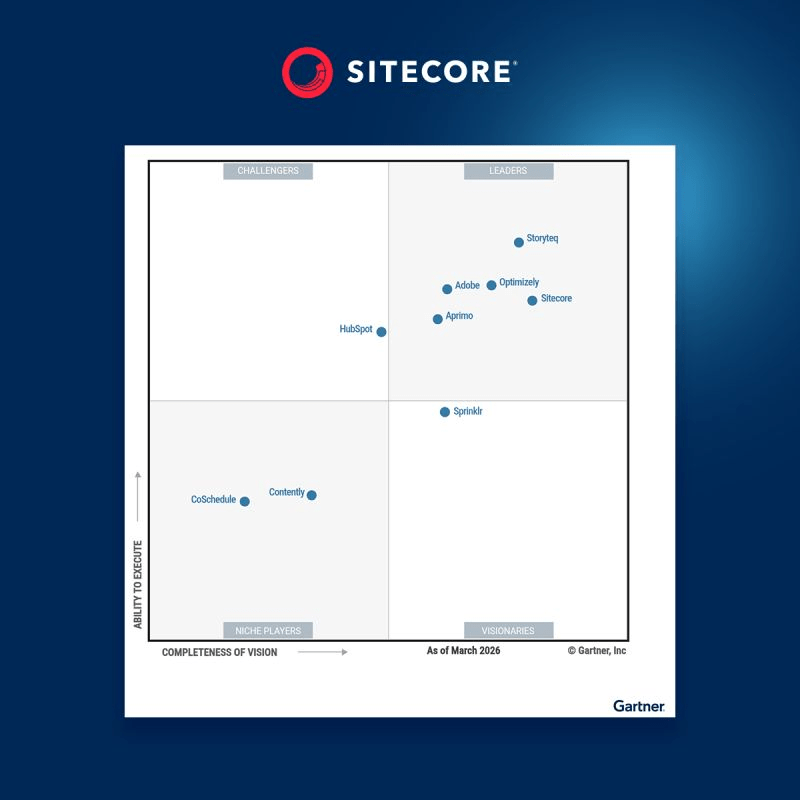
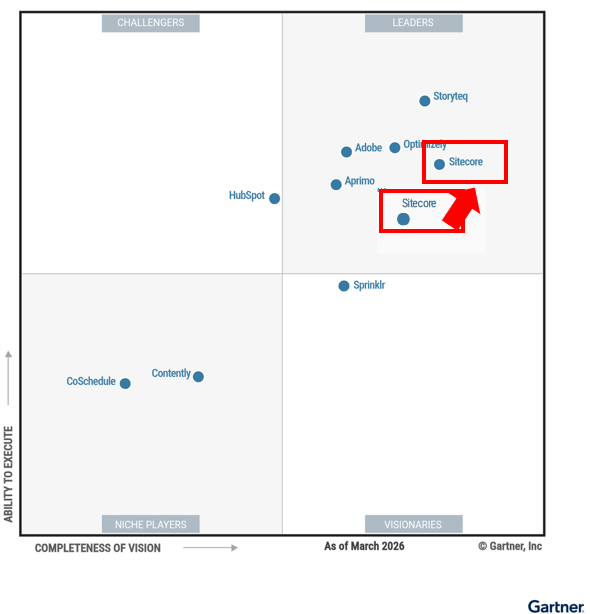
This week, Gartner published the 2026 edition. Sitecore is a Leader again – and has moved further right on Completeness of Vision than in any previous report.
That’s not a lucky year. That’s a direction.
Why the Journey Matters More Than the Destination
Anyone can land in a Magic Quadrant. The more interesting story is whether a vendor moves, and which way.
Looking across the three reports:
2022 – Sitecore is a Visionary. The Content Hub product is recognised for where it’s going, but Gartner isn’t yet convinced on execution.
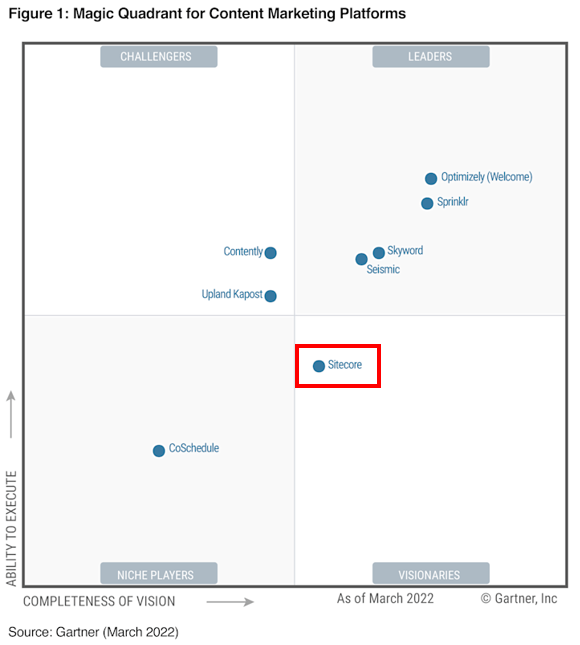
2024 – Sitecore crosses into Leaders. The platform has matured, the DAM-first architecture is proving out, and the composable stack is starting to land with global enterprises.
2026 – Sitecore holds the Leader position and extends its vision score. Agentic automation, C2PA provenance tracking and the SitecoreAI roadmap are the things Gartner specifically calls out.
For anyone who has been working with Content Hub through that period, this feels less like a surprise and more like validation. The platform was always heading here. The analyst community has caught up.
What Gartner Actually Recognised in 2026
Three strengths worth reading carefully, because they’re specific rather than generic.
Agentic automation – Gartner named SitecoreAI Agentic Studio and the ability to orchestrate multiagent workflows for research, localisation and brand safety. The C2PA provenance tracking embedded directly into those workflows was called out as a genuine differentiator for regulated industries. This is in production, not on a roadmap slide.
Governed content operation – the framing here is deliberate. Not content management, but a governed operation – with compliance and provenance tracking built into the platform rather than added on. For enterprises managing content across multiple markets and regulatory environments, that’s a structural advantage.
Portfolio breadth – the composable stack combining WCM, DAM, MRM and product content management in a single shared model was recognised as genuinely differentiated. Not just good bundling. The shared data model is what makes the AI layer credible.
To be fair, Gartner also flagged three cautions: UI/UX inconsistency across the suite (unification not expected until end of 2026), organisational restructuring as the SitecoreAI pivot continues, and some pricing complexity for buyers who want Content Hub stand-alone. These are worth a direct conversation with Sitecore before signing anything.
How the Rest of the Field Is Moving
The 2026 Leader quadrant has five vendors: Adobe, Aprimo, Optimizely, Sitecore and Storyteq. But the Leader label doesn’t mean equal, and some of the positioning in this report tells a more complicated story.
Adobe entered this Magic Quadrant for the first time as a Challenger in 2024 – notable given the scale of the company and the breadth of its creative ecosystem. It moved to Leader in 2025 and holds that position in 2026. The vision and market understanding are clearly there. But Gartner’s caution on pricing is worth reading in full. There are no published list prices for GenStudio. It’s described as a collection of applications rather than a distinct product. SKUs aren’t expected until later in 2026. For any organisation trying to build a business case with predictable costs, negotiating blind across multiple licenses and product editions is a real procurement problem, not a minor footnote.
Optimizely has been a Leader for nine consecutive years – that consistency is real and worth acknowledging. But look at where they sat in the 2024 chart versus 2026 and something interesting is happening. They were clearly out front in 2024, positioned at the top of the Leaders quadrant with daylight between them and the rest. In 2026 they’re still Leaders, but the field has compressed significantly around them. Storyteq is right alongside them. Sitecore has moved up on vision. The gap that existed two years ago is gone.
Gartner’s caution explains part of why. Engineering resource has been redirected from core CMP development to Opal, their AI orchestration layer. The note is measured but deliberate – this shift could moderate the pace of core CMP enhancements. Nine years as a Leader is a strong track record. But in a market moving this fast, standing still on your core product while betting on a new layer is a risk worth understanding before you commit. If Opal delivers, the bet pays off. If it doesn’t, the CMP underneath it hasn’t been advancing at the same pace as the competition.
Aprimo is also a Leader, and genuinely strong on API-first composability and content intelligence. The caution is in the build – the base subscription is rooted in DAM, and you’ll need to purchase separate add-on modules to get to full CMP functionality covering work management, campaign planning, budget management and real-time personalisation. The architecture is flexible, but the cost and configuration overhead adds up before you’re fully operational.
Sprinklr sits in Visionary – credible vision, strong on social-led content, good global footprint. But Gartner flagged that major releases run on a quarterly cadence. In a market where the leading platforms are shipping continuously, quarterly updates means watching competitors move while you wait for your next feature drop. For enterprises where content operations agility is a priority, that rhythm is worth factoring in.
What This Means If You’re a Content Hub Customer
If you’re already on Content Hub, this report should give you confidence that the platform direction is sound. The capabilities Gartner recognised in 2026 – agentic orchestration, governed workflows, composable architecture – are built on the same foundation you’ve been running on.
The SitecoreAI roadmap isn’t a pivot away from Content Hub. It’s Content Hub, matured into an AI-native operating layer. The things that made it the right platform choice are the same things that make the AI story credible now.
If you’re evaluating Content Hub for the first time, the trajectory across three reports is your clearest signal. Platforms that consistently move in one direction on a Gartner chart tend to keep moving that way. The cautions Gartner raised are fair questions to take into your vendor conversations – especially around the 2026 pricing model and UI unification timeline.
Final Thought
The content marketing platform market has moved dramatically in four years. Agentic AI has taken over from GenAI as the dominant story. Answer engine optimisation is replacing traditional SEO as the content strategy lens. Integrated suites are outpacing stand-alone tools.
Sitecore has moved in the right direction through all of it. That’s what this report confirms – and honestly, for those of us who have been close to Content Hub, it’s what we already knew.


 Tim's Blog
Leave a Reply