

Search has traditionally been treated as something that sits on top of content.
- You index pages,
- You index assets,
- You index product data
And hope the search engine can stitch something useful together.
It works well enough for customer-facing search, but internally it leaves a huge gap.
- You can find things, but you can’t understand how they fit together.
- You can’t see the risk around a change.
- You can’t check readiness across channels.
- You can’t see dependencies or spot inconsistencies.
This all changes the moment the platform sits on a unified backbone.
What is a backbone
A unified backbone is not just another index.
It is a shared, authoritative model that stores content, data, and most importantly, the relationships between them. This can be implemented using graph principles, but the key point is not the technology. It’s the structure.
A backbone gives meaning to your content estate.
Instead of disconnected records, everything is connected through explicit relationships. Content, assets, products, taxonomy, workflow states, variants, channels, and rights all exist in a single, connected model.
When search runs on top of that, it stops being a retrieval tool and becomes a discovery tool.
The difference is huge.

Why Search Struggles Without a Backbone
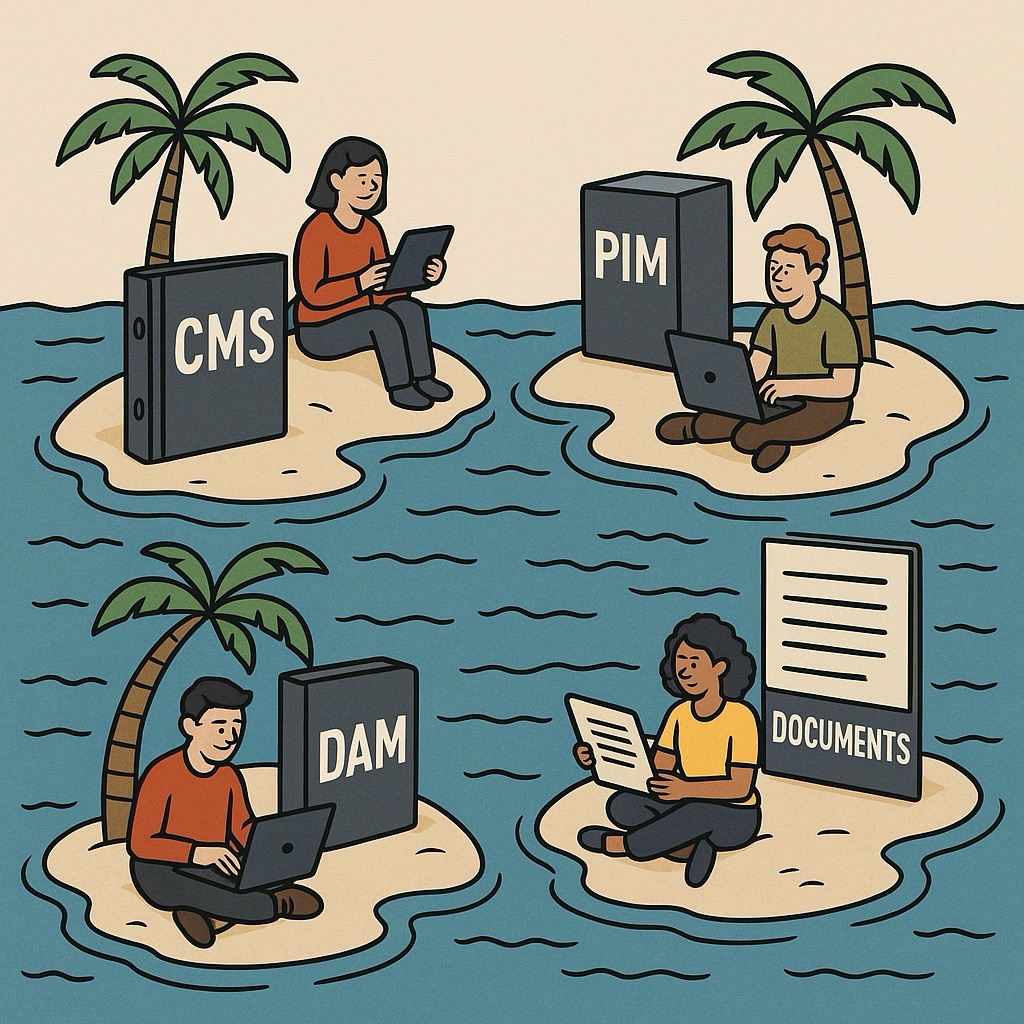
When you index CMS items, DAM assets, PIM data, and documents separately, you create islands.
Each island is searchable on its own, but none of them understand each other.
That means:
- You can find an item, but not what depends on it
- You can see an asset, but not every place it’s used
- You can see a workflow state, but not the content it impacts
- You can see a product, but not the channels it appears in
This limits search to simple queries. Anything richer requires manual detective work across tools.

What a Backbone Actually Adds
A unified backbone changes the foundation.
It doesn’t matter whether that backbone is implemented as a graph service, an entity model or a structured content fabric. What matters is that everything is referenced consistently.
The backbone holds the links between:
- Content → Assets
- Assets → Products
- Products → Taxonomy
- Taxonomy → Regions
- Regions → Channels
- Channels → Variants
- Variants → Workflow states
- Workflow states → Rights and compliance

Now search isn’t just scanning text. It’s reading relationships.
This means the platform can answer questions that used to take teams days to piece together.
Search Becomes a Window Into the Content Ecosystem
Once search understands relationships, you can start asking different questions.
These are the kinds of queries organisations actually need, but can’t answer today.
Imagine these industries asking these queries to a unified backbone:
Retail:
You manufacture and sell high-end trainers used across ecommerce, campaigns, marketplaces, and partner sites.
You are updating the packaging of a flagship trainer ahead of the London Marathon, where you are a major sponsor.

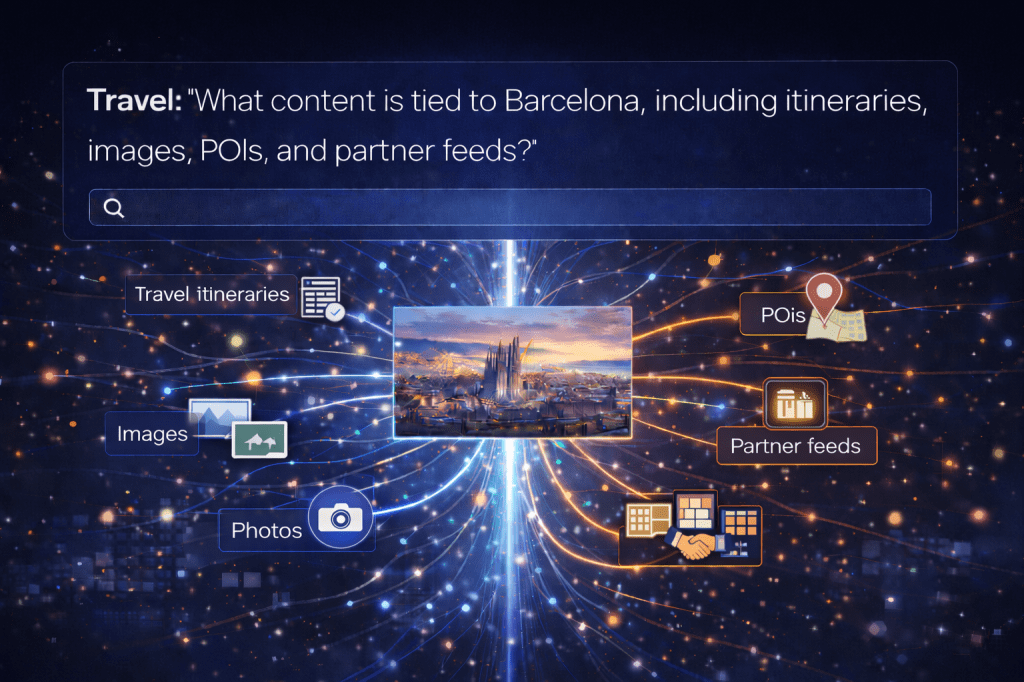
Travel:
You are a global travel guidebook web content business. You are currently producing over 700 titles for various locations around the world.
2026 is time for you to refresh your Barcelona book which was last updated 5 years ago. So you want to find all content attached to Barcelona.
Healthcare:
You are a global pharmaceutical company that has products and ingredients that are used in other manufactures products.
A core product is updated that is used as the base for multiple other products. What does this mean? You have to update everything you have as soon possible including manufactures, packaging and information that use your product.
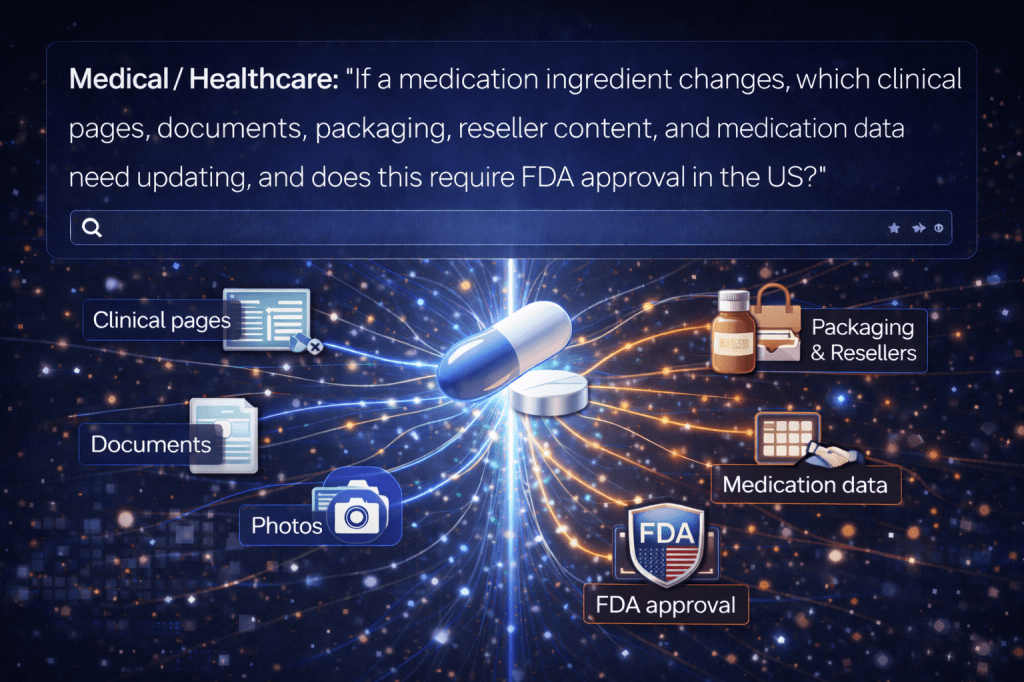
These aren’t search results. They’re insights. And you only get them when search is grounded in a connected model.

Search Reflects the Live State of the Organisation
Because a backbone is always being updated via:
- Workflows
- Imports
- AI suggestions
- Variant generation
- Channel changes
- Content Update
- DRM
- Anything
Search becomes a live reflection of the organisation’s digital state.
Search becomes the system’s health monitor, not just its lookup tool.
How SitecoreAI Turns the Backbone Into an Intelligent System
A unified backbone is what makes AI useful at scale.
Without it, AI is forced to infer relationships from text and metadata. With it, AI can reason over real structure.
This is where Sitecore AI becomes powerful.
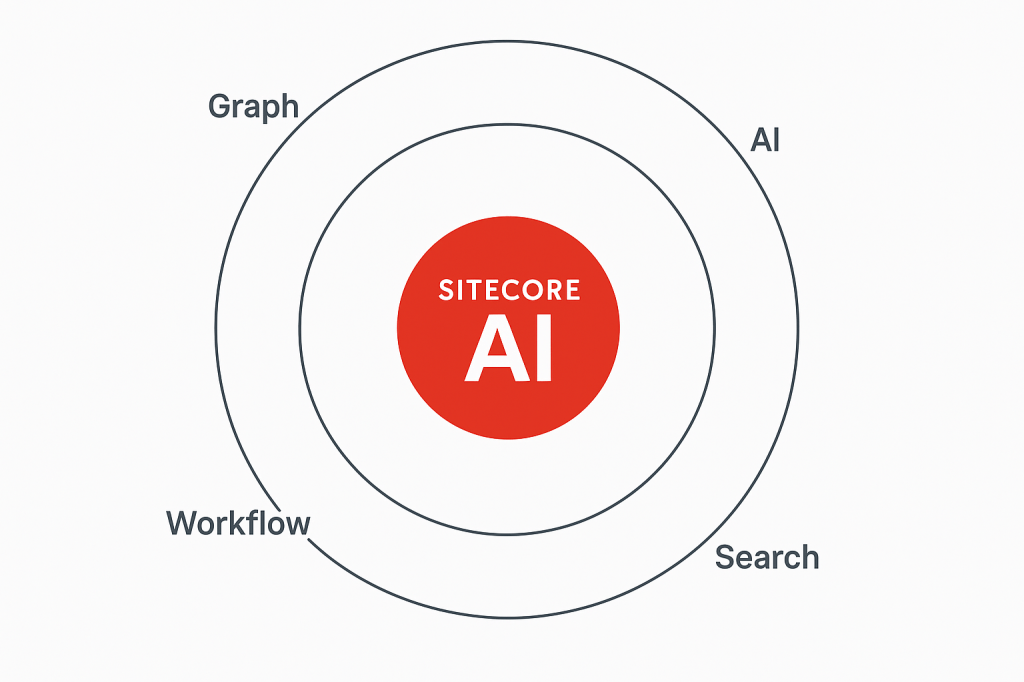
Because SitecoreAI operates directly on the backbone, it doesn’t just analyse content in isolation. It understands how content, assets, products, taxonomy, workflow states, channels, and rights relate to each other in real time.
That changes what AI can safely and reliably do.
SitecoreAI can:
- Understand the impact of a change before it happens
- Detect broken or risky relationships across channels
- Identify inconsistencies between variants, regions, and formats
- Cluster content based on how it is used, not just how it reads
- Surface gaps in readiness, compliance, or localisation
- Recommend next best actions grounded in the actual state of the platform
This is not AI guessing based on patterns alone.
It is AI reasoning over a connected model.
Why This Matters
As organisations generate more content, more variants, and more AI-assisted outputs, manual governance simply does not scale.
SitecoreAI works because it is grounded in a unified backbone.
The backbone provides truth.
Search provides visibility.
AI provides insight and guidance.
Together, they turn the platform from a content repository into an intelligent content operating system for digital experience.


 Tim's Blog
Leave a Reply