


Introduction
In today’s content-driven world, organizations need more than just a basic content repository – they need solutions that can manage content, assets, product data, print and media, marketing resources, brand resources ideally in a unified way.
There are not many products out there that can work across channel effectively.
In my opinion Sitecore Content Hub rises to that challenge as a comprehensive platform that uniquely combines loads in a single integrated hub.

It offers businesses a single source of truth for content and assets, coupled with tools for planning, collaboration, and automation. The result is a versatile system that fits any industry or use case. As I wrote in another blog, “Content Hub has the perfect mix of capabilities that can help businesses grow and succeed…couple this with the flexibility of Content Hub and you have an unbeatable ecosystem”
In short, Sitecore Content Hub is a unique and unmatched solution for enterprise content needs.
Let me pose some challenges and how Sitecore is the right solution.
Streamlined Workflow Automation for any business
Efficient content operations require smooth workflows. Sitecore Content Hub provides powerful workflow automation that streamlines every step of the content lifecycle. Teams can define custom workflows for content creation, review, approvals, and publication, ensuring that each piece of content goes through the right process automatically.
This advanced workflow capability means Content Hub can mirror your organization’s processes, not the other way around.

The platform can automatically route tasks to the right team members, send notifications, and trigger actions (for example, publishing content or alerting stakeholders) without manual intervention.
By automating and tailoring workflows, businesses accelerate time-to-market for content and eliminate bottlenecks in approval cycles, all while maintaining full oversight of each project’s status.
Centralized Digital Asset Management (DAM)
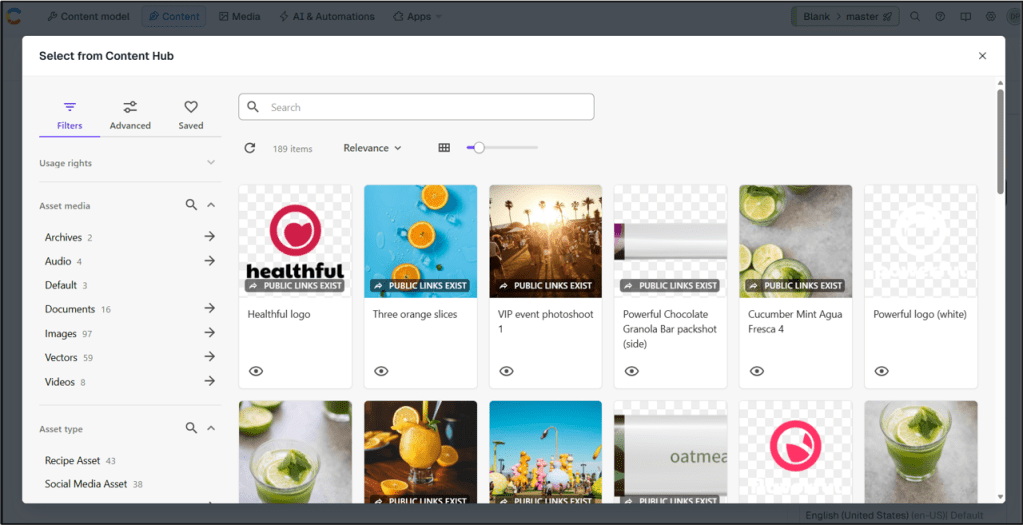
At its core, Sitecore Content Hub is a world-class Digital Asset Management (DAM) system. It acts as a centralized repository for all your digital assets – images, videos, documents, graphics, and more – serving as the single source of truth for marketing and product collateral. This centralization ensures consistency, simplifies management, and facilitates easy access across various channels.
In practice, teams across the organization can easily find and reuse approved assets rather than reinventing the wheel or hunting through siloed folders. Sitecore’s DAM allows you to organize assets with rich metadata and taxonomies, and its robust search (even AI-assisted search capabilities) makes retrieval effortless.
For decision-makers, this means better brand consistency and far less wasted effort. Whether you’re managing a library of product photos or a vault of brand videos, Content Hub’s DAM ensures everyone – from marketing to e-commerce to design – can leverage the same up-to-date assets in their initiatives.
Content Marketing Platform (CMP) for Unified Content Creation
Basically build once, localise then use anywhere.
Beyond managing assets, Sitecore Content Hub includes a full Content Marketing Platform (CMP) that revolutionizes how teams plan and produce content. With CMP, marketers and content creators get a centralized workspace to ideate, draft, and collaborate on everything from blog posts and articles to campaign copy and social media content.
CMP addresses the common pain of content scattered in silos across different markets or channels. It’s designed to solve the problem of content duplication by building content atoms and reusing them across each of your channels, even allowing teams to localize master content for different languages or regions automatically
Flexible Versioning and Variants for Asset Flexibility
In a multi-channel, multi-region business, one-size-fits-all content rarely works. Sitecore Content Hub excels in providing versioning and variants features that give you tremendous flexibility with your assets and content. Users can maintain multiple versions of a content item or asset (for example, an old version, a new draft, region-specific versions) and link variant content together – all without duplicating entries. This capability is an absolute stand-out feature in Content Hub: users can create new versions and linked variants easily in a few clicks.
Product Content Management (PCM) for E-Commerce and Catalogs
For companies with product catalogs—especially those in retail, manufacturing, or e-commerce—Sitecore Content Hub offers Product Content Management (PCM) capabilities that centralize and streamline product data management. Rather than managing product information in spreadsheets or multiple separate PIM systems, PCM in Content Hub allows you to maintain all product descriptions, specifications, pricing details, and digital assets in one place, centralising for marketing. This module helps you manage product information across various channels, ensuring that all channels (e-commerce website, print catalogs, marketplaces, etc.) pull from accurate, consistent product data
Marketing Resource Management (MRM) for Campaign Oversight
Marketing teams juggle complex campaigns, budgets, and timelines. The Marketing Resource Management (MRM) capabilities within Sitecore Content Hub give organizations the tools to oversee and optimize these marketing operations. With MRM, you can plan campaigns and projects, allocate and track budgets, manage content calendars, and coordinate your marketing resources all through Content Hub’s interface. It provides a birds-eye view of all ongoing marketing activities and their status. Sitecore’s marketing project management (MRM) module offers features to manage budgets, track performance, and guarantee efficient use of marketing resources.
In practice, this means marketing managers can ensure that every campaign stays on schedule and on budget, with clear accountability for tasks. For example, you can set up a campaign project in Content Hub, attach all related content items (from CMP) and digital assets (from DAM) to it, assign team members, and define milestones. As content pieces move through their automated workflows, the project dashboard updates in real-time.
By consolidating marketing work management into the same hub as your content, Sitecore Content Hub eliminates the need for separate project management tools for marketing and ensures tight alignment between content creation and campaign execution.
Tailored Solutions with Custom React Components
One of the reasons Sitecore Content Hub can fit any business is its extensibility. The platform is designed to be customized – not just configured – to meet unique requirements. In fact, each capability is amazing but for me the real power is in the way you can expand the platform, you can extend it via integrations, custom data models, and React JS components to enrich the user experience
This means if you have a special use case or need a custom interface element, you’re not limited by out-of-the-box features. For example, you might create a custom React component for a tailored dashboard, a specialized content input form, or a button that performs a complex multi-step action (like sending asset metadata to another business system).
With this capability, even highly specific business processes or niche industry requirements can be accommodated by building a bit of custom code on top of the platform. The key takeaway for decision-makers is that Content Hub won’t paint you into a corner – its rich set of features covers most needs out-of-the-box, and it gives you the flexibility to adapt the system further.
This level of customization is a major differentiator, ensuring that the platform can be tailored to your business, rather than forcing your business to conform to the software. The result is a solution that can evolve with you: as your needs change or new opportunities arise (say, integrating with a new tool or supporting a new content type), Content Hub can be extended to handle it.
Comparing Sitecore Content Hub to Alternative Solutions
Given Content Hub’s broad capabilities, one might wonder how it stacks up against other solutions in the market. There are point solutions and legacy systems for individual needs (for example, standalone DAM software like Bynder or traditional PIM and MRM tools) that address pieces of the content puzzle.
However (in my opinion), no single alternative brings together the breadth of Sitecore Content Hub’s features with the same level of integration and flexibility.
Competing DAM platforms often focus on a narrower scope. For instance, Bynder is known as a user-friendly DAM, but it might lack some advanced features that businesses with complex needs might require and can face limitations in handling large-scale operations as those needs grow
In other cases, organizations attempt to stitch together multiple products – one for DAM, another for PIM, another for content planning – only to encounter siloed data and costly integrations. Sitecore Content Hub eliminates those gaps by providing a unified experience.
In contrast, Content Hub was built for scalability and composability, making it ideal for medium to large enterprises that need a comprehensive, one-stop content platform
In short, alternative solutions may cover one or two facets of what Sitecore Content Hub offers, but none provide the all-in-one platform with the depth and extensibility that Content Hub delivers. This makes Content Hub not just a product, but a strategic investment that can replace or consolidate several other systems.
Conclusion: An Unmatched Content Platform
Enterprise decision-makers evaluating content solutions will find that Sitecore Content Hub stands out as a singularly powerful option. It combines the traditionally separate domains of DAM, content marketing, product content management, and marketing resource management into one integrated hub, complete with automation and customization capabilities to adapt to any scenario.
This means less complexity in your tech stack, consistent experiences for users, and a faster path from content creation to delivery.
Sitecore Content Hub is in a league of its own


 Tim's Blog
Leave a Reply