


Businesses are increasingly reliant on content management systems (CMS) to keep their content operations running smoothly. However content is normally duplicated, fragmented and built for single channels.
As teams grow and content diversifies, tracking changes, versions, and linked variations becomes a daunting task.
I work with Sitecore Content Hub a lot and it’s one of them products that offers a lot of versatility. While it has all the enterprise features of a DAM, it also has advanced content features that differentiate in the market as a CMP leader.
Content Hub was recently named a leader in the 2024 Gartner Magic Quadrant for Content Marketing Platforms

This is why I see CMP platforms as the next evolution, users can build content not worrying about its layout and have advanced features to build it quickly and easily.
This blog isn’t about CMP but about ideas on managing content version’s and tracing them effectively. while this could be accomplished with other platforms I know Sitecore can do all of this and I’ll refer to it as Content Hub throughout.
The Importance of Versioning and Traceability
Versioning and traceability are critical components of effective content management. They allow businesses to maintain a clear record of all changes, track the evolution of content over time, and ensure that all team members are working with the most up-to-date information.
Key Features of a Content Management Platform for managing versions and variations
- Language Localizations: Managing content in multiple languages is crucial for global businesses. Content Hub supports language localizations, ensuring that each version of the content is accurately represented and easily accessible.
- Numbered Versions: Keeping track of content versions helps in understanding the history and changes made to any piece of content. Each version is numbered and stored, making it easy to revert to previous versions if necessary.
- Target Group-Specific Variants: Different audience segments often require tailored content. Variants allow content creators to make specific adjustments for different target groups, all while keeping everything traceable back to the original source.
How It Works
Sitecore Content Hub provides mechanisms to manage different versions of the same content, as shown in the image below:

Versioning
Versions take the previous item and create a copy for editing. These copies can then be published for use on the portal, ensuring that the latest updates are always available to users.
Variants
Separate variants can be created for each item to enable target group-specific adjustments. These variants remain fully traceable to the source items, ensuring consistency and accuracy.
Localizations
Localizations are created from the latest available version of the master item.
They are actually a variant themselves but I wanted to call out that a localization could be different.
Each localization can have its own version published, allowing for precise control over regional content.
Older versions are automatically archived upon the publication of a new version, ensuring a clean and organized content repository.
Smooth Content Targeting with Content Hub
Distributing and targeting content effectively is key to engaging the right audience. Content Hub makes this process seamless by enabling content authors and ensuring that content consumers see exactly what they need.
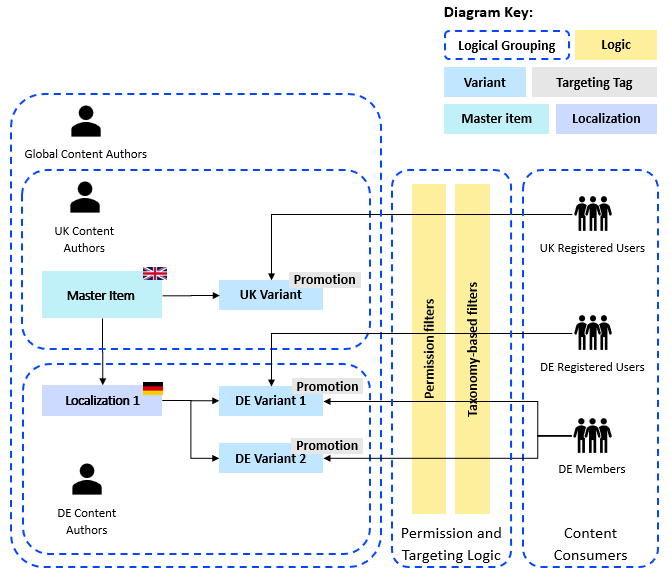
Enabling Content Authors
The platform is configured to allow content authors an intuitive way to assemble and distribute content to the appropriate job roles. Authors can control regional or global content based on their permissions, making the content creation process efficient and targeted.
Content Consumers’ Experience
Content consumers on the portal see only the content they are allowed to access, based on their role and needs. This targeted approach ensures that the right content reaches the right people at the right time.
Comparing Versions Easily
The Content Hub’s Content Marketing Platform (CMP) keeps track of every version change and easily displays all versions. This is combined with a comparison tool that highlights differences between each version, making it simple for users to understand what has changed, which version, and by whom.

Version History and Comparison
The version history shows the version, date created, current primary version, and an easy restore option. Highlighted additions and deletions ensure that users know exactly what has changed.
Conclusion
In summary, Content Hub addresses the gap I’m seeing in content management by providing comprehensive tools for versioning, traceability, and content targeting.
By implementing it or something similar, businesses can ensure their content is well-organized, easily accessible, and precisely targeted, leading to improved efficiency and engagement.


 Tim's Blog
Leave a Reply